
DFD6561Fully Automatic Dicing Saw
A space-saving solution for Φ300 mm dicing
- Φ300 mm
- Facing dual spindle
Space-saving layout
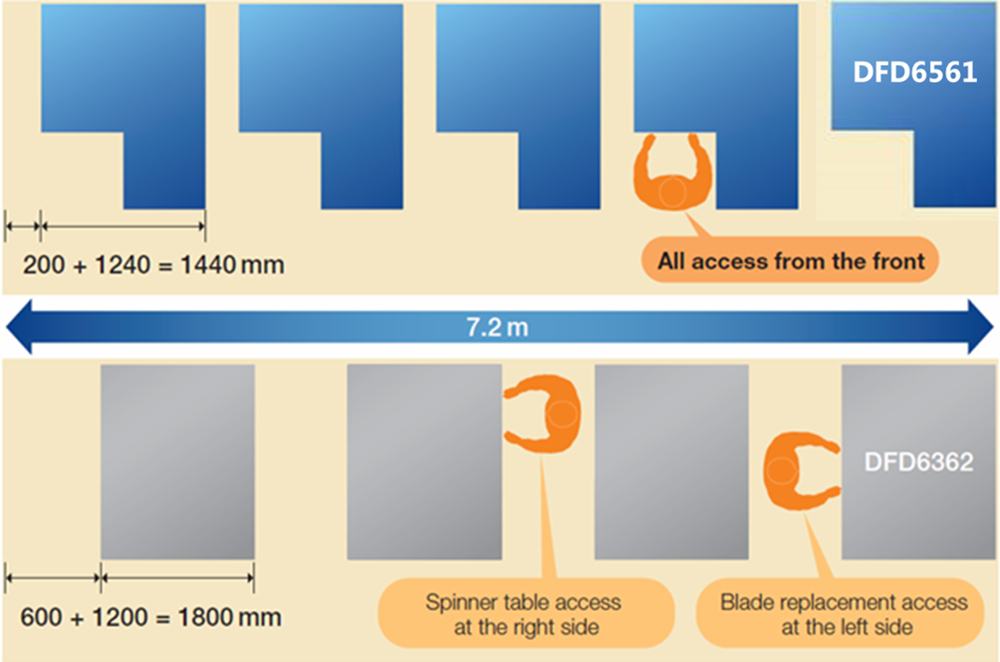
DFD6561 is equipped with uniquely developed short spindles and an optimized bridge-type frame structure resulting in a 16% reduced footprint. All maintenance can be performed from the front of the equipment, thus reducing the area needed for installation and maintenance areas by 20% (compared to the DFD6362). The DFD6561 is particularly ideal when installing multiple adjacent units.
Intuitive operation for operator ease
The LCD panel allows touch operation of the alignment teach function. Important data, such as the equipment condition and mean time between assists (MTBA) is also displayed on screen, allowing the operator to easily confirm the status of the equipment. Onscreen error recovery assistance is also available.

High-rigidity spindle
Adoption of high rigidity spindle achieves increased processing stability.
Non-contact setup
The NCS (Non-Contact Setup) measures the blade wear amount with high accuracy and speed.
Synchronized dicing axis (X, Y, and Z) control
Measures the height of the chuck table to which the wafer will be secured in advance and controls the blade cutting depth with high accuracy (user-specified).
Options for particle prevention
Users can select optional particle prevention measures used in other models, such as the cut section atomizing nozzle and spinner atomizing nozzle. A chuck table water curtain, which prevents particle adhesion caused by wafer drying, is also available.
Concentrated maintenance area
All operations, from routine to maintenance, can be performed from the front of the equipment. The space reduction achieved in the DFD6561 allows 5 units to be lined up in a space which would only fit 4 units for the DFD6362 at a production facility.
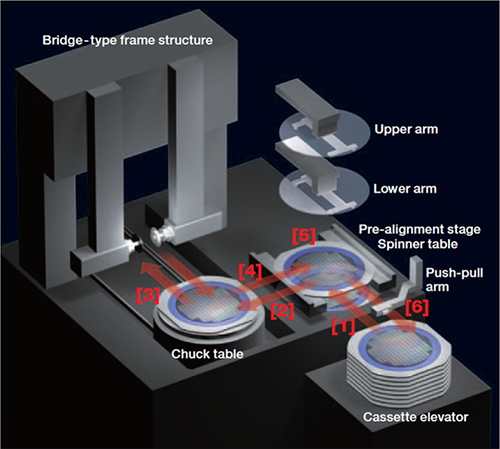
DFD6561 operation flow
- Push-pull arm moves the workpiece from the cassette to the pre-alignment stage →
- After centering at the pre-alignment stage, the lower arm moves the workpiece to the chuck table →
-
Cutting →
- Upper arm moves the workpiece to the spinner table →
-
Cleaning and drying → Lower arm moves the workpiece to the pre-alignment stage →
- Push-pull arm returns the workpiece to the cassette.
List of optional specifications


 Application
A high-torque spindle that supports large diameter blades and difficult-to-process materials.

 Application
Ultrasonic-assisted dicing with a blade vibration method that improves processing performance for difficult-to-process materials such as glass and ceramics.

 Blade condition
A mechanism that detects the blade tip position through setup using a transmissive sensor. Prevents damage to the blade edge and improves processing quality. With the latest model of NCS, measurement time is reduced and UPH improves. (NCS: Non-Contact Setup)

 Automation
An automation mechanism for blade replacement. Eliminates downtime while waiting for an operator and operation errors, thereby improving equipment operability. Record management is possible by automatically recording the wafers and the blade used.

 Blade condition
A specification for an additional sub-C/T. Enables interval dressing during workpiece processing.

 Blade condition
A specification in which the PRECUTBOARD® is mounted on the tape frame and loaded from the frame cassette. The precutting process can be automated with this specification.

 Blade condition
A specification in which the PRECUTBOARD® is mounted on the tape frame and loaded from the inspection stage. The precutting process can be automated with this specification.

 Blade condition
A function to scan the 2D barcode on the PRECUTBOARD® on the sub-C/T and cross-check with the device data to prevent precutting errors.

 Cutting accuracy
A mechanism in which a laser sensor tracks various types of measured surfaces such as based on the workpiece top surface, based on the backside due to Si transmission, and based on the top side of the surface layer. Enables highly-accurate cut depth control.

 Cutting accuracy
A mechanism in which cut depth is controlled based on the workpiece top surface that is measured using a back pressure sensor.

 Cutting accuracy
A mechanism that measures the height of workpieces for which contact with a touch sensor is possible, such as package substrates. Enables cut depth control in accordance with the height of measured points.

 Cutting accuracy
A function to automatically perform warm-up before processing when the equipment has been stopped for a longer period than the set period in order to make the processing accuracy stable.

 Labor saving
One-touch blade replacement specification. Reduces blade replacement time and prevents operation errors. (for hub blades)

 Labor saving
One-touch blade replacement specification. Reduces blade replacement time and prevents operation errors. (for hubless blades)

 Labor saving
A set of jigs including a torque driver for nutless flanges.

 Application
A mechanism in which the slits of the blade cooler nozzle are enlarged in order to increase the amount of cooling water. Effective for workpieces with a large processing load.

 Countermeasure for particles
A specification with a 3 o'clock nozzle and spray duct. Prevents particles from spreading on the workpiece surface.

 Countermeasure for particles
A specification with a V nozzle and spray duct. Prevents particles from spreading to the die by enclosing the wheel with the wheel cover.

 Application
A specification that improves cutting water supply to the processing point with enlarged slits in the cooler nozzle and deep-cut nozzle. Effective for workpieces with a large processing load.

 Countermeasure for particles
A wheel cover with a cutting section atomizing nozzle specification that improves cleaning performance. Can be used with hub blades. (BBA: Blade cooler with Built-in Atomizing nozzle)

 Countermeasure for particles
Performs forced exhaust with a wheel cover that is directly connected to the duct. Efficiently discharges mist and particles that are generated around the processing point.

 Countermeasure for particles
A function to remove foreign objects on the C/T after cutting using C/T blow and air curtain.

 Automation
A UV irradiation unit for UV curing-type dicing tapes. Achieves uniform irradiation, accurate light intensity control, and energy saving.

 Automation
A specification that supports a process to semi-cure the UV tape adhesive before cutting with a UV irradiation unit. Effective in reducing backside chipping and adhesive residue during cutting.

 Automation
A specification that skips cutting and only performs UV irradiation.

 Support for workpieces
C/T and spinner table that support square workpieces (253 × 253 mm) such as package substrates.

 Support for workpieces
A function that sets the contact setup position when a square table is used.

 Support for workpieces
A tape frame that supports square tables (253 × 253 mm). (DTFS250-01)

 Support for workpieces
A specification with an IR microscope. Enables transmissive alignment for workpieces such as bonded wafers.

 Application
A specification that adds a micro microscope on the Z2-axis. Increases the speed of kerf check during dual cut and improves UPH.

 Support for workpieces
Enables selection of an optimal microscope magnification for observing the workpiece surface. Standard magnification is approx. 300x. Applied to both axes when the micro microscope for the Z2-axis is selected.

 Support for workpieces
A function that recognizes the workpiece shape with a camera. Improves UPH by reducing alignment errors and applying cut strokes in accordance with the workpiece shape when cutting wafer pieces.

 Countermeasure for particles
A mechanism that provides continuous water supply to the entire workpiece surface during processing. Prevents the workpiece surface from drying out and suppresses contamination.

 Application
A specification with a flow checker instead of a flow rate controller. Effective when cutting liquid is used or when the flow rate needs to be visually checked.

 Support for workpieces
A specification with a stainless cover on the X-axis bellows. Prevents breakage of bellows due to remnants from QFN substrates.

 Utility
A built-in type duct fan that improves mist discharge performance when the duct air flow is small.

 Antistatic
A mechanism that uses ions to neutralize static electricity and reduce electrostatic charge. It effectively suppresses static charge buildup on the workpiece and reduces the risk of electrostatic damage.

 Antistatic
A unit that adjusts resistivity by dissolving carbon dioxide in DI water. Reduces electrostatic charging and particle adhesion on workpieces.

 Antistatic
A unit with an ionizer and antistatic spinner table. Suppresses separation charge.

 Countermeasure for particles
A specification in which inline filters are inserted in clean air piping for devices such as image sensors.

 Countermeasure for particles
A spinner nozzle that discharges a mixed fluid of DI water and clean air onto the workpiece. Improves cleaning performance.

 Countermeasure for particles
A spinner nozzle that discharges a mixed fluid of DI water and clean air onto the workpiece. This is a highly clean type and higher cleaning performance than the S-type atomizing nozzle is expected.

 Countermeasure for particles
A monitoring function with a flow rate sensor added to the spinner atomizing cleaning mechanism. Enables flow rate monitoring both for water and air.

 Countermeasure for particles
A piping specification for secondary cleaning liquid usage during spinner cleaning.

 Blade condition
A dressing function to correct the blade tip to a flat shape by moving the axis in the Y direction. This operation should be performed manually.

 Blade condition
A dressing function to correct the blade tip to a flat shape by moving the axis in the Y direction. Flat dressing can be performed even during processing by using a sub-C/T for the dresser board.

 Blade condition
A dressing function to correct the blade tip to a flat shape by moving the axis in the Y direction. Flat dressing is automatically performed with the dresser board mounted on the tape frame and set to the dedicated slot.

 Alignment method
A function to decide the cutting position by performing alignment with multiple cutting lines in accordance with the settings. Effective for workpieces with warpage such as package substrates.

 Alignment method
A function to decide the cutting position by performing alignment with multiple cutting lines in accordance with the settings. Effective for round-shaped workpieces with distortion.

 Alignment method
Performs alignment based on the symmetry of the image in the vertical direction across the street, and the center line becomes the cut line. Effective for wafers with different street widths.

 Alignment method
A function to perform alignment based on the detected workpiece edge and determine the cut line. Effective for wafers without patterns.

 Alignment method
A function to detect workpiece position deviation from the C/T center. Enables cut position adjustment during edge-stop cut or edge trimming.

 Alignment method
A function to perform alignment using two targets. Effective for workpieces such as package products with different targets on the right and left sides.

 Alignment method
A function that performs image recognition based on the outline of the alignment target. Effective when contrast is low or adhered particles are present on the workpiece during observation using a microscope.

 Alignment method
A function that recognizes the target on the workpiece front side again after standard alignment and adjusts the cut position. Effective when cutting line position deviation occurs between the workpiece center and edge due to issues such as workpiece distortion.

 Support for workpieces
A function to recognize die layout and adjust the θ position within the range of ± 45 degrees. Effective when there is a large workpiece mounting variation in the θ direction in relation to the tape frame.

 Application
A processing method to perform a chopper and traverse cut on the workpiece without cutting all the way through.

 Shape creation
Processing in which the θ-axis is rotated and a height difference is formed on the wafer edge. Effective in reducing edge cracking during wafer thinning.

 Shape creation
Processing in which the θ-axis is rotated and wafers are cut out in a circle shape. Effective in creating wafers for verification.

 Cut sequence
A setting for not cutting the wafer edge so that the wafer is not completely cut. Prevents scattering of triangular die on the wafer edge.

 Cut sequence
A function to adjust feed speed around the start and end of the cutting line. Prevents meandering due to the arc of the wafer edge.

 Cut sequence
A function to unify the cut progression directions of all axes during dual cut. Equalizes the effects of chipping.

 Cut sequence
Cut sequence that prevents the blade from coming into contact with the tape frame when the tape frame is not pulled down during cutting. Used when tension should not be applied to the dicing tape.

 Inspection
A function to check the quality of wafers cut on streets after laser grooving.

 Inspection
A function to compare microscope images before and after cutting and detect the area that has changed as the kerf. Effective for workpieces with kerfs that are hard to see, such as semi-transparent workpieces.

 Usability
A melody is played instead of an alarm when full-auto operation is completed or the operator is being called.

 Communication
Installed with a communication port to input/output data to/from external sources. Compatible with LAN and RS232C.

 Communication
Installed with communication software that complies with SECS/GEM.

 Communication
Installed with communication software that complies with GEM300.

 Traceability
Hardware for reading barcode labels on the tape frame.

 Traceability
Hardware for reading barcode labels on the cassette and blade case.

 Traceability
A function to automatically set the registered device data in accordance with the barcode information on the tape frame.

 Traceability
A function to automatically set the blade information upon replacement in accordance with the barcode information on the blade case.

 Communication
Software that records information obtained through sensors inside the equipment and saves the data in CSV format. Communication with an external server is also possible.

 Communication
A network system for connecting multiple DISCO equipment units. Contributes to improved productivity through functions such as operation monitoring, remote control, and graphed data obtained with sensors inside the equipment.

 Application
An external unit that injects StayClean (additive for cutting water) and monitors its concentration in conjunction with equipment operation.

 Utility
A separate unit that maintains the temperature of cutting water and cooling water so that processing accuracy remains stable.

 Utility
A built-in unit that supplies power from a battery to equipment in case of power failure or voltage drop. When power failure continues, shutdown will be safely performed.

 Utility
A step-down transformer unit that is needed when equipment is used with 3-phase AC 380-415 V.

 Utility
A pump-up unit that is needed when the pressure of DI water is low.

 Utility
A pump to pressurize spinner cleaning water within the set pressure range.

 Utility
An external cover made of stainless steel.

 Usability
Protects operator from upward and downward movements of the elevator by adding a cover on the cassette stage section.

 Utility
Metal fixture to secure equipment to the floor. Prevents equipment from falling over in case of disasters such as an earthquake.

 Utility
A dedicated drain pan placed beneath the equipment base.

 Utility
A water leakage detection unit that can be additionally installed to the drain pan. Shuts down water supply when water leakage is detected.

 Countermeasure for particles
A filter unit suitable for cutting water, cooling water, and cleaning water.

 Countermeasure for particles
An external unit to suction the mist discharged with the forced exhaust specification.


A set of jigs for 2-inch hub mounts that are necessary for blade installation, including a torque driver, removal jigs, and conditioning jigs.


A set of jigs for 3-inch hub mounts that are necessary for blade installation, including a torque driver, removal jigs, and conditioning jigs.


A set of jigs for R-type flanges for blade installation, including a torque driver, removal jigs, and conditioning jigs.


A set of jigs for S-type flanges for blade installation, including a torque driver, removal jigs, and conditioning jigs.


R-type flanges of different sizes.


S-type flanges of different sizes. (supports 2.2 kW spindle)


A set of jigs for hoisting equipment when moving the equipment upon installation, etc.

 Countermeasure for particles
An air gun with a higher blow pressure than the standard.

 Usability
A pen for operating the touchscreen.


A measurement instrument to check the exhaust duct capacity.


A set containing a Phillips screwdriver, flathead screwdriver, Allen wrench, and open ended wrench.


A set containing an oilstone, precision screwdriver, adjustable angle wrench, dial gauge, and grease injector.


Parts and consumables needed for maintenance and part replacement performed every 365 days.


A ring-shaped jig for securing workpieces using tape. This is a high-accuracy product aiming for stable operation from tape mounting to die bonding. The Φ300mm specification complies with SEMI G77.


A cassette used for storing wafers mounted on tape frames. This is a high-accuracy product aiming for stable operation from tape mounting to die bonding. The Φ300mm specification complies with SEMI G77.
Specifications
| Specification | Unit | 1.8 kW | High-speed rotation (option) | |
|---|---|---|---|---|
| Max. workpiece size | mm | Φ300 | ||
| X-axis | Cutting range | mm | 310 | |
| Cutting speed | mm/s | 0.1 ~ 1,000 | ||
| Y1・Y2-axis | Cutting range | mm | 310 | |
| Index step | mm | 0.0001 | ||
| Positioning accuracy | mm | Within 0.002/310 (Single error) Within 0.002/5 |
||
| Z-axis | Max. stroke | mm | 14.2 (For Φ2 inch blade) | |
| Moving resolution | mm | 0.0000002 | ||
| Repeatability accuracy | mm | 0.001 | ||
| θ-axis | Max. rotating angle | deg | 380 | |
| Spindle | Rated torque | N・m | 0.29 | 0.19 |
| Rotation speed range | min‐1 | 6,000 ~ 60,000 | 20,000 ~ 80,000 | |
| Equipment dimensions(W×D×H) | mm | 1,240 × 1,550 × 1,800 | 81mm convex (left side) | |
| Equipment weight | kg | Approx. 1,500 | ||
*Product appearance, features, specifications, and other details may change due to technical
modifications.
*Please read the standard specification sheet thoroughly before use.
Product Lineup
| Equipment type |
| Spindle |
| C/T |
| Dimensions(W × D × H) |
| Weight(kg) |
 |  |  |  |  |  |  |  |  |  |  |
| DFD6240 | DFD6340 | DFD6341 | DFD6342 | DFD6361 | DFD6362 | DFD6363 | DFD6450 | DFD6560 | DFD6750 | DFD6760 |
| Fully Automatic | Fully Automatic | Fully Automatic | Fully Automatic | Fully Automatic | Fully Automatic | Fully Automatic | Fully Automatic | Fully Automatic | Fully Automatic | Fully Automatic |
| 1 | 2 | 2 | 2 | 2 | 2 | 2 | 2 | 2 | 2 | 2 |
| 1 | 1 | 1 | 1 | 1 | 1 | 1 | 1 | 1 | 2 | 2 |
| 900 × 1190 × 1800 | 1180 × 1110 × 1850 | 1180 × 1080 × 1820 | 1180 × 1080 × 1800 | 1200 × 1550 × 1800 | 1200 × 1550 × 1800 | 1200 × 1550 × 1800 | 1120 × 1500 × 1600 | 1240 × 1550 × 1960 | 1510 × 1554 × 1800 | 1200 × 1900 × 1800 |
| 1200 | 1600 | 1500 | 1240 | 2050 | 2050 | 1800 | 1400 | 1640 | 2200 | 2800 |
DFD6561Fully Automatic Dicing Saw
Contact
Please feel free to contact us with any questions or inquiries.